



Introduction to microcapsule technology
Microcapsules are formed by wrapping tiny particles or droplets with materials that are easy to form films, thereby forming micron- or nano-capsule-type embedded materials with core/shell structures and uniform sizes.
Specifically, the target core material (such as oils, probiotics, flavor substances, food additives, fat-soluble nutrients, pesticides, cosmetics, enzymes, drugs, and adhesives, etc.) is wrapped in a wall material of natural polymer materials (such as polysaccharides, proteins or lipids) to form an "egg-like" encapsulation system to achieve the purpose of changing the physical state, isolating and protecting, or slow-release and taste masking.

Selection of core material and wall material
The choice of core material depends on the specific application requirements and can be organic, inorganic, gas, or liquid. The wall material needs to be selected according to the properties of the core material and the desired encapsulation effect. The wall material should have good film-forming properties, high stability, and good compatibility with the core material. Common wall materials include natural polymer materials (such as gelatin, and gum Arabic), semi-synthetic polymer materials (such as carboxymethyl cellulose), and synthetic polymer materials (such as polyurethane, and polyester).
Microcapsule technology
According to the physical state of nutrients, suitable adhesives and excipients are selected, multi-dimensional granulation technology is used, the particle size distribution of nutrients is precisely controlled, and one or more layers of film coating are coated to achieve effective embedding.

Use natural polymer materials to wrap functional oils or oil-soluble core materials to form microvesicles, forming an oil-in-water (O/W) emulsified structure, and after drying, powdered oil with uniform particles is formed.
Advantages of microcapsules
1. Change physical properties
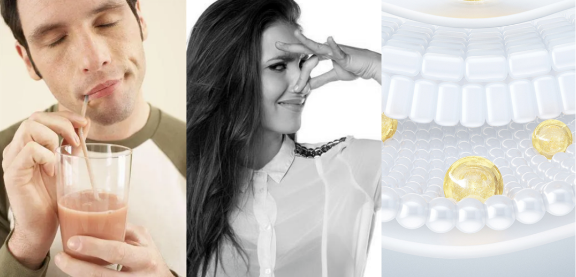
Since the hydrophobic groups of the core material are wrapped by the wall material, the hydrophilic groups of the wall material used are exposed, which greatly improves the water solubility of the core material. Due to the supporting structure of the wall material, the mechanical resistance of the core material is increased. It is widely used in beverages, solid beverages, compressed candies, and other products, which greatly broadens the scope of application.

2. Masking taste and stable protection
On the one hand, due to the different release degrees of the wall material (encapsulation material) to different core materials, the release rate of the core material can also be controlled to achieve the purpose of sustained release. At the same time, according to the hydration capacity of the wall material, the oral release rate is reduced to achieve the effect of masking the taste.
On the other hand, microcapsules reduce the odor emission, oxidation, degradation, and volatilization of the core material due to exposure to external light, heat, and oxygen, and prevent the probability of reaction between the different components contained, to protect the core material, extend the shelf life and mask the odor.
3. Improve absorption efficiency
Due to the targeting and sustained-release effect of the microcapsule powder after embedding, it can greatly reduce gastrointestinal adverse reactions and promote absorption; at the same time, compared with the original and groups, the shell group has better biocompatibility, which can effectively improve the absorption efficiency of the core material.

HSF Microcapsule Series Products
HSF SoliPro™ Granulation Coating Microcapsule Powder Series
When HSF Granulation Coating Technology was first developed, it was to serve the expansion of the plant sterol application market. It developed granular and instant plant sterols, which received good responses. To better meet the global market's demand for personalized and stable development of functional ingredients, it innovatively solved the application problems of most ingredients, such as poor water solubility, poor stability, strong odor, low bioavailability, and uncontrolled release rate. Since the establishment of the Modification Engineering Laboratory, it has provided more than 500 solutions and conducted thousands of tests each year for different material requirements, accumulating a large amount of experience and materials, and can quickly feedback solutions based on material characteristics and customer needs.

HSF VegeLipi™ Functional Oil Microcapsule Powder Series
HSF's microcapsule technology is constantly polished in actual production and line with higher requirements from customers. To improve the fluidity, solubility, and other qualities of the product, we start from the basic optimization of drying parameters, and gradually carry out systematic experiments for different materials, using different proportions, water-oil ratios, and emulsification homogenization pressure, pH value, and temperature to maximize the embedding rate of the target material and reduce the surface oil of the finished product. A scientific self-developed emulsification system has been established to match the optimal microcapsule solution according to the physical properties of different materials. To further improve the product's strength, Beadlets microencapsulation technology has been developed to enhance the pressure resistance of microcapsules and increase the application areas of microcapsules for tableting. Alternatively, multiple embedding of microcapsules can be completed through Wurster spray granulation, and the taste masking and moisture-proof effects of microcapsules can be enhanced directionally.

For more details, please contact us:
Email: sales@healthfulbio.com
Whatsapp: +86 18992720900