


Nature provides a wealth of natural product resources for the treatment of many diseases. Between 1981 and 2014, approximately 46% of the drugs approved by the Food and Drug Administration (FDA) were based on natural products or their derivatives. At present, many dietary supplements, especially polyphenols, have been shown to be effective in treating many diseases including fibroinflammatory diseases. Ferulic acid (4-hydroxy-3-methoxycinnamic acid, ferulic acid, FA) is a natural polyphenol with potential antioxidant and anti-inflammatory properties. It is widely found in coffee, peanuts, artichokes, beans, corn, and grains. , Wheat, oats, fruits and vegetables (such as bamboo shoots, tomatoes, beetroot, eggplant).
Idiopathic pulmonary fibrosis (Idiopathic pulmonary fibrosis) is a fatal chronic developmental lung disease characterized by worsening lung function and excessive deposition of extracellular matrix (ECM) protein in lung tissue. It is the most serious inhibitory disease among various interstitial lung diseases. Pulmonary fibrosis (PF) is caused by multiple damages to the lungs, including autoimmunity, drug induction, infection, traumatic injury, or exposure to certain substances (such as silica) in the environment. Occupational exposure to silica will exacerbate PF by inducing a cascade of reactive oxygen species and inflammation, which will cause irreversible damage to normal lung structures. However, the current treatment methods for PF are very limited, the treatment effect is not significant, and some drugs are prone to cause greater side effects. Researchers will study whether the potential biological properties of ferulic acid can effectively prevent pulmonary fibrosis.
Recently, the Venu Talla team of the National Institute of Pharmaceutical Education, India, explored the protection of inflammation and fibrosis signaling pathways and the molecular mechanism of ferulic acid in a silica-induced pulmonary fibrosis model. Related results were published in the international journal Food and Chemical Toxicology with the title "Ferulic acid ameliorates the progression of pulmonary fibrosis via inhibition of TGF-β/smad signalling".
The results showed that ferulic acid can significantly improve the abnormal lung morphology and the increase of lung index caused by silica, and improve the migration of inflammatory cells in BALF (including total cells, lymphocytes, macrophages, neutrophils). Cells and leukocytes), alleviate lung pathological lesions and ECM precipitation, and at the same time alleviate tissue oxidative stress and elevated nitrite levels in the PF model induced by silica. X-ray observation of the lungs revealed diffuse alveolar consolidation 14 days after the induction of silica. This change is common in the early stage of PF, and ferulic acid can partially reverse the pathological damage caused by silica. Inflammation plays an important role in the pathogenesis of PF. Researchers found that the levels of TNF-α, IL-6 and IL-1β in the silica group increased significantly, and ferulic acid could significantly reduce the expression of these pro-inflammatory factors. . Silica can induce the increase of total collagen content in lung tissues and up-regulate the TGF-β signaling pathway, while ferulic acid can down-regulate signaling pathway proteins closely related to the fibrogenesis pathway (including collagen-I, CTGF, slug and p-smad2/3) expression improves silica-induced PF lesions. Finally, the researchers also proved that ferulic acid can improve the silicon dioxide-induced epithelial to mesenchymal transition (EMT) process and protect lung tissue lesions. The researchers also proved that the high-dose ferulic acid used in a single gavage experiment did not induce any potential pulmonary toxicity, proving the protective effect of ferulic acid on silicon dioxide-induced lung injury.
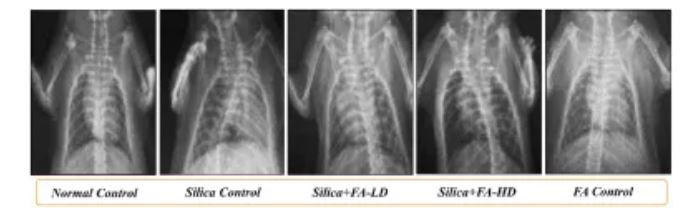
Representative X-ray pictures of lungs
Analysis conclusion
The team demonstrated that in animal models, ferulic acid slowed down the process of pulmonary fibrosis by inhibiting TGF-β-mediated downstream signaling, and found that the protective effect of ferulic acid was partly due to its effects on oxidative stress, inflammation, and promoting The effective inhibition of fibrosis signals is achieved. These findings indicate that ferulic acid can be used as an intervention agent to improve disease by targeting the TGF-β/smad signaling pathway.